BBC Radiophonic Workshop - The Soundhouse

Tuesday, 4 October 2016 - Reviewed by Martin Ruddock

Originally released 1983

CD/vinyl album by Malcolm Clarke, Jonathan Gibbs
Paddy Kingsland, Roger Limb, Dick Mills,
and Elizabeth Parker

Released 7th October 2016, Silva Screen Records

The latest of Silva Screen’s series of reissues of BBC Radiophonic Workshop albums shows the collective in their 80s pomp, having long since abandoned tape loops and slide rules for then state of the art synthesisers. The Soundhouse, from 1983 showcases their love affair with the Fairlight CMI, the first digital sampling synthesiser, over 22 tracks spanning 1979-83. This revolutionary machine opened up doors to a new kind of impressionistic pop music in the hands of Peter Gabriel and Kate Bush. In the hands of the workshop it’s put to perhaps slightly more conventional melodic use, but the results are still pleasingly weird.

The Soundhouse features tracks by house composers Peter Howell, Jonathan Gibbs, Roger Limb, Elizabeth Parker, Paddy Kingsland, Malcolm Clarke, and veteran effects and ideas man Dick Mills.

The opening Radiophonic Rock is a group effort, with only Kingsland and Clarke sitting it out, whilst the other five go mad in Maida Vale. Everyone gets their own distinct part, and it's quite, quite bonkers. It’s fairly typical of the Workshop’s output of the time, its four minutes are pretty much a CV for the group, and sets the tone for the album pretty well. One minute it evokes Jean-Michel Jarre, the next minute we’re into a jaunty ditty like Gibbs’ Computers in the Real World or Limb’s Rallyman, which is part glacial New Wave Synthpop and part current-affairs programme theme. Dick Mills’ contributions like Seascape and Catch The Wind are all ambient atmosphere, swirling flanged drones that could almost be Brian Eno outtakes, and his anarchic Armagiddean War Games is the sound of a man surrounded by machines having a bit of a party. Liz Parker’s work is under-represented here, but her serene, spacey Planet Earth is a highlight.

Howell and Limb, meanwhile, experiment on a couple of tracks with putting the synths in the background and putting more traditional instruments to the fore, like in Howell’s Lascaux, and Limb’s haunting Ghost in the Water, which is one of the best tracks here.

There’s more of the typical 80s workshop sound courtesy of Kingsland and Howell, all languid pads and familiar plinks and plonks - but the real ‘stars’ of the collection are some very familiar tracks by Kingsland from The Hitch-Hiker’s Guide to the Galaxy, including the unmistakable strains of the synth-sailor’s hornpipe, The Whale.

The album ends on Malcolm Clarke’s The Milonga, the baroque ball music familiar from its use in Doctor Who, in the ‘pirate ball’ scene from Enlightenment - once heard, never forgotten, even if you’re not the kind of fan who can identify a Who cue from 50 yards.

The Soundhouse doesn’t have the mystique of the trail-blazing days of Delia Derbyshire's oscillators and found sounds, but it’s still crammed with quirky innovation and invention. The sounds that the second generation Workshop sculpted may have come from Synthesisers rather than being coaxed from household objects and coaxed into something unearthly, but they’re just as pioneering in their own way.


FILTER: - BBC Radiophonic Workshop - Silva Screen - CD - Vinyl - Dick Mills - Peter Howell - Malcolm Clarke - Roger Limb - Elizabeth Parker - Jonathan Gibbs

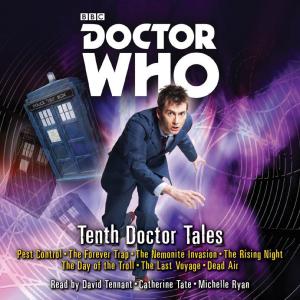
Doctor Who - The Tenth Doctor Tales (BBC Audio)

Tuesday, 20 September 2016 - Reviewed by Matt Tiley
Tenth Doctor Tales (Credit: BBC Audio)
Doctor Who: Tenth Doctor Tales: 10th Doctor Audio
Original Audio CD – Unabridged
Read By David Tennat, Catherine Tate and Michelle Ryan

This compilation released by BBC Audio August 2016
Buy from Amazon UK
Pest Control (Parts One and Two) - By Peter Anghelides - Read by David Tennant.

On the planet of Recension, a bitter war is being raged between humans and the Aquabi. When Dr McCoy (The Tenth Doctor) and Captain Kirk (Donna Noble) arrive, they not only face the wrath of each side, but also a monstrous plan that mutates soldiers into giant insects, and a huge metal robot exterminator.

Pest control has the advantage of (in my opinion) the greatest Doctor and companion team that the series has provided us since it's return in 2005. Peter Anghelides writes for them perfectly, and David Tennant turns in a surprisingly good Donna. The story conjures up some fantastic imagery, especially the transformation of the soldiers into the giant insects (which is always accompanied by wonderfully horrendous sound effects), and the giant metal robot, whose sole job is to eradicate the insectoids by stamping on them. The story does plod a little in the middle, and Tennant's voicing of Surgeon Lenova sounds as if it is unintentionally comedic, but on the whole this is an exciting audio with some lovely Star Trek in jokes.


The Forever Trap - (Parts One and Two) - By 15094 - Read by Catherine Tate.

The Doctor and Donna are duped into being flatmates in a huge luxury apartment complex called The Edifice. They soon discover that not all of their neighbours are particularly friendly, in fact some are just out and out murderous...

As anyone who has seen The Catherine Tate show will know, Tate is by nature a master of creating different voices, and here she gives them all character (my favourite being the overtly camp lift attendant). The Doctor and Donna's chemistry is present in the writing, but the comparison to Paradise Towers (not one of my favourites) was too much, meaning the story didn't quite work for me.


The Nemomite Invasion - (Parts One and Two) - By David Roden - Read by Catherine Tate.

A frantic chase through the time vortex, a splash landing and a flooded TARDIS herald the Doctor and Donna's arrival in World War 2. They are tracking an alien parasite that is intent on taking over all human life on Earth.

This story starts at breakneck speed, with the Doctor and Donna crashing into the English Channel in the middle of U Boat battle. The threat here is an alien slug-like creature, that attaches itself to the host, and spreads it's young through the water supply. The story is full of very tense and creepy moments, with the Doctor having to make some very hard decisions. Again Tate excels at voicing the different characters (there are a lot of them), and keeps the listener's attention throughout.


The Rising Night - (Parts One and Two) - By Scott Handcock - Read by Michelle Ryan

The Doctor finds himself in 18th century Yorkshire, with no idea how he arrived. Women are being kidnapped, and men murdered - the Doctor of course is the prime suspect. Something is feasting on the blood of the villagers, meaning the Doctor must prove his innocence and catch a monster. His only ally being a young woman called Charity.

I found the Rising Night quite hard to get into, the story took a lot of time to get going, and I am not sure that Michelle Ryan's vocal talents helped. However things finally get wrapped up nicely, and in the end the Doctor finds himself with a new travelling companion.


The Day Of The Troll (Parts One and Two) - By Simon Messingham - Read by David Tennant.

In the future, England has become a barren, arid wasteland. The Doctor discovers a team of scientists who are trying to help the environment, unfortunately for them all, an ancient evil is hunting them down one by one.

The Day of The Troll has the tenth Doctor in his element, leading a group of terrified scientists in a what is initially a base under siege scenario. The second half suffers a bit from bringing the characters out in the open a little, but the monster is terrific, and with the help of some subtle sound effects, Tennant really gives it air of terror. The story reminded me a lot of John Pertwee's era, in that not only did the Doctor have to face off against an alien threat, but also the establishment. With the Doctor here traveling alone, Tennant really excels in his characterisation of him.


The Last Voyage (Parts One and Two) - By 15094 - Read by David Tennant.

The Doctor joins the flight of a revolutionary transposition cruiser, where he finds that almost all of the passengers and crew have mysteriously disappeared, and an alien threat starts to manifest itself.

Dan Abnett here writes out an out science fiction, with the craft in the story bending space and time to reach it's final destination. The realisation of the dimension hopping aliens is fantastic, with the terrifying way that they seep into our reality. There is though unfortunately an issue with one of the characters, Sugar, whom Tennant voices in a REALLY annoying American accent that I just couldn't take seriously. Still the story is tied up nicely, in a way that makes perfect sense.


Dead Air (Parts One and Two) - By James Goss - Read by David Tennant.

On a pirate radio boat in 1966, the Doctor and the crew are faced by a hostile alien that not only feeds on pure sound, but is also the perfect mimic. Who can he trust?

The alien threat onboard the Pirate Radio ship Bravo is outstanding, The Hush is a malevolent presence that the Doctor has been tracking that feeds on sound. However as the story progresses, it mutates into something far more threatening. The use of sound in Dead Air is brilliant. Where ever the alien has been, there are pockets of silence. Imagine walking into a room talking, and suddenly you can't hear anything, not even the words that are coming from your own mouth. Goss has created a monster that would be welcome in show on television. Capaldi would have a field day.


On the whole The Tenth Doctor Tales is a worthy listen, if a tad long. I felt that because of the running time (each complete story is around the two hour mark) some of the stories outstayed their welcome somewhat. Tennant and Tate are excellent narrators, Tennant using his own accent when not in character, and Tate of course excelling at handling the different characters voices and personalities. I did feel though that Ryan's delivery fell somewhat flat.


The stand out story for me was Dead Air. The Hush is a truly unsettling monster that works perfectly in audio. James Goss has created an instant classic. Tennant's Doctor is made to be properly vulnerable in Hush, in a similar way that he was in television's. Dead Air is a truly disturbing listen. On the other side, the weak point for me was The Rising Night. The story was too slow, and could easily have been cut to one hour.


BBC Audio here prove that they can indeed make interesting, entertaining and engaging audios, that rival Big Finish.


FILTER: - BBC Audio - Tenth Doctor - Audio

Illegal Alien (AudioBook)

Monday, 19 September 2016 - Reviewed by Martin Hudecek
Illegal Alien (Credit: BBC Audio)

Written By: Mike Tucker + Robert Perry
Read By: Sophie Aldred
Voices Of The Cybermen: Nicholas Briggs


Publisher: BBC Audio
Released: 28th July 2016

Duration: 543 Minutes 

American private detective Cody McBride witnesses the arrival of the sphere, and is certain it opened, allowing some alien being to depart its confines. But the British military will only credit McBride's account of events as a German weapon, that has 'accidently failed' to work. It is November 1940 and Britain is enduring the Blitz, with the Second World War dominating human affairs. As the Luftwaffe wreak devastation on London, other dangers are not far away. A brutal murderer, branded as 'The Limehouse Lurker', is at large around the streets of the capital that have sustained attack. And a mysterious silver sphere has fallen from the sky. Its contents could bring massive change to the fortunes of the two sides in the War.

However, soon he encounters two bizarrely dressed people that call themselves 'the Doctor' and 'Ace', and they very much give credit to his account. And many more odd events are about to happen now McBride is involved with people who can seemingly navigate the fourth dimension of space and time...


Once again, as with other books featuring earlier Doctors, BBC Audio has released another such title to bring to full life a story that was popular enough with fans and general readers to merit a re-release in recent times.  When this story first hit shelves in late 1997, it perhaps came across as rather 'traditional' and 'safe', given how many original novels of the decade aimed to break new ground. But in its defence, it was originally conceived as a properly made TV story featuring Sylvester McCoy and Sophie Aldred. Of course, the infamous cancellation of the classic series put paid to any realisation of the story onscreen. And if anything the story would have been very ambitious for TV, and here benefits from expansion to a full novel.

The narrative fundamentally is a simple one, but does have a notable number of subplots and allows for certain characters' back stories to be sketched out in detail. For the most part, the listener is left in no doubt over the virtues or vices of the supporting characters.

On one side we have clearly brave and good-intentioned people such as McBride and Chief Inspector Patrick Mullen. 

And on the other end of the spectrum, are a number of deplorable Nazis and/or their conspirators, with notable antagonists being Captain Hartmann, Colonel Schott, and the creepy Mr Wall.

But, then there is one key character that is more shades of grey, and who is a real intellectual match for the Doctor. He almost evokes some sympathy, but his methods are still deplorable, and he clearly leans towards the amoral and indifferent stance, despite all the suffering and devastation going on around him. Despite this story being nigh on 20 years old, I will leave it to the individual listener to go on the path of seeing which character I am describing.


Mike Tucker and Robert Perry not only know how to pace their story well, but how to achieve effective inter-relations between the personalities that populate the novel. There is plenty of fine material for either the 'one-to-one' or 'group' dynamic, with it being most effective when featuring the leading lights, that are the Seventh Doctor, and his still very exuberant teenage protégé Ace. The authors are well-versed in the McCoy section of Classic Doctor Who, and there is never a moment when the complex character that is the Seventh Doctor feels any less than authentic. And, in terms of this being not just a dramatic story, but a thriller as well, there is sufficient depiction of war and monstrosity in equal measure.  Cyber body horror is done very well here, and the full lethal potential of the Cybermats is also explored in commendable fashion. Some aspects of Cyber-Lore, that were new to this book at the time, have since gone on to feature in New Who stories such as The Pandorica Opens and Nightmare In Silver.


Sophie Aldred is as impressive here as in any audio book or full cast drama I have heard her in previously. In the audio release Dark ConvoyI had a small reservation with her being forced to convey a group of characters that were all male. But with time to use the prose and character development here, she grasps fully the opportunities afforded to her to show her vocal range. And yet again, her own defining voice/performance of Ace works just as well, as when first unveiled in 1987 

The actual vocals for the Cybermen are handled by Nicholas Briggs - who has clearly become the definitive voice of the metal conquerors at this point - and work well, both in tying with modern TV stories, but also a vintage 1960s TV escapade. This bit of continuity work is given just a passing bit of exposure in the wholly satisfying epilogue to the novel.

There are some fine bursts of incidental music, which never linger too long, but do add successfully to the overall impact of this audiobook. They are particularly strong when a chapter ends or one of the four 'episodes' reaches a climax, (with Tucker and Perry being determined to retain the original TV serial structure in this book version). The 'shooting' signature noise designed to evoke the Blitz is quite effective in its unsettling intent, and helps remind listeners this is not just an entertaining work of fiction but something with roots in our own world history and reality.

Ultimately, Illegal Alien is best described as a rattling good yarn. It is worthy of unequivocal recommendation for anyone who feels the Seventh Doctor and Ace TV stories deserved more entries, than what eventually transpired in actuality. 


FILTER: - BBC - AUDIO - SEVENTH DOCTOR - CYBERMEN

The Macra Terror (AudioBook)

Sunday, 11 September 2016 - Reviewed by Martin Hudecek
Doctor Who: The Macra Terror (Credit: BBC Audio)
Written by Ian Stuart Black,
Read by Anneke Wills,

First published by Target Books in 1987,
Released by BBC Audio - 4 August 2016.
Running time: 3 hours,  5 mins

In the 24th Century, a human colony enjoy a truly enviable lifestyle in their domain, which in many ways resembles a holiday camp from yester-century. Conformity and contentment go hand in hand, as everyone serves the interests of a society that runs like clockwork and never shows anything other than a positive demeanour.

But one of their own, a bearded and fidgety man called Medok suddenly insinuates that foul creatures are taking over control. No-one wants to believe his rather alarmist claims though, at least that is until a crew of four strangers arrive out of the blue...


This story has grown steadily in my affections over the years as a fan of Doctor Who, and also someone interested in social science and philosophy in general. I first encountered it when it came out at the same time as The Evil Of The Daleks on dual audio cassette in 1992. 

As a child back then I would devoutly replay these releases on my portable Sony 'Walkman' when travelling somewhere new, yet I would only fully engage with David Whitaker's epic.

Macra was just a curiosity. Not even a solitary episode existed, and having the Sixth Doctor / Colin Baker as the narrator somehow felt more opaque than the definitive (especially back then) Fourth Doctor/ Tom Baker.

But over time I have realised how the Season Four finale does suffer slightly from its seven episodes, and multiple locations, even if it remains great escapism. Macra is however concise, ascends in its suspense and feeling of high stakes, and makes the most of its overall premise.


As of today, only The Power Of The Daleks stands head and shoulders higher over this tale, as the marquee story of a season of Doctor Who, that said 'goodbye' to one talented actor in the lead, and 'hello' to an arguably more skilful thespian. Of course now we have the news that the debut Troughton story will make a comeback of sorts in the coming months, in the form of an exciting and newly envisioned animation.

For a great story to exist in the first place, it invariably needs a very strong and confident writer. Ian Stuart Black is one of the perhaps more under-rated scribes in Who lore and should be thanked for giving the show a vital shot in the arm when it began to falter in the latter half of Season Three. Today, we only have The War Machines (essentially intact), whilst Black's other two efforts - The Savages, and this story - are lost almost entirely. All three do however deserve to be remembered fondly.

I do think Macra is the cleverest and boldest of Black's three televisual serials. The novelization here accomplishes admirably efficient world building whilst maintaining the pace of the 'snappy' four parter structure.


The story has much to make the readership ponder themes and philosophy. One of the more overt is the need to be sceptical and questioning over what a person is told, and how they should invariably conform. If there is not enough of this independent thought, then the individual is in danger of losing their array of senses, and to be effectively brainwashed. Each chapter has something to say about the subliminal techniques used by the story's antagonists to wield power, and this manipulation is effective primarily due to the victim' sense of being euphoric and having the perfect life.

By making Ben Jackson the most susceptible of the TARDIS crew, when normally he is the most argumentative and dominant in nature, the original TV story managed to take viewers at the time on a journey where they questioned if what they thought they knew about the show's heroes was perhaps more superficial than first thought.

There is also a very strong amount of in-depth exploration on the nature of what is acceptable in society, and what is 'eccentric' or 'insane'. The various references to insanity and to hospitalisation/medication that controls said malady are as relevant to today's social confines, where the idea of normal is so strongly prioritised, they were in the 'swinging' Sixties, when this story was conceived (and had its regrettably one-off UK transmission).

The fate of one of the key guest characters of the story is also altered. Whereas in the transmitted story this person seemed to meet an abrupt end, in this version the author was allowed to present an alternative fate, as he held the full reins as the writer of the novelization. Consequently this key player in proceedings is allowed a fully formed arc and a sense of vindication.


And as an audio book, this stands up rather well too. Anneke Wills does a very respectable job in showing her range of skills, as the sole member of a one person cast. Many guest actors in the original show were strong, not least Peter Jeffrey (as the 'Pilot'), who later went on to have an even better role as the more villainous Count Grendel in the Tom Baker Era. But Wills uses the rich text of the book to narrate events and characters vividly, and switches personas for the various members of the colony distinctly and with full attention to detail.

The only niggling issue I have is that whilst her Second Doctor portrayal has much of the core mercurial spirit of Patrick Troughton, the actual voice - in terms of pitch - is more akin to William Hartnell. But I must admit, this is one area that is rather easy to criticise, much like Maureen O'Brien could only gamely attempt to portray her Doctor in The Space Museum, released earlier this year. Sometimes the sheer star quality of the main man in this sci-fi/fantasy phenomenon can be a double edged sword...


Sound effects and musical cues are well up to the usual standard for these BBC Audio releases. Such is the strength of the core text, and the dedicated, whole-hearted presence of Anneke Wills, these supporting elements act as a nice bit of icing on the cake, rather than something to break up a potential monologue. Whether you are clued-up on classic Who like myself, or someone who has only glimpsed the Macra in the Tenth Doctor belter Gridlock, this is a great addition to your audio collection. This late summer release lives up to the legacy of the sadly missing black and white BBC production.


FILTER: - SECOND DOCTOR - TARGET BOOKS - BBC AUDIO - Audio

Doctor Who and the Sontaran Experiment (audiobook)

Thursday, 11 August 2016 - Reviewed by Matthew Kilburn
Doctor Who and The Sontaran Experiment (Credit: BBC Audio)
Written by Ian Marter
Read by Jon Culshaw
Released by BBC Audio on 7 July 2016
First published by W.H. Allen & Co. Ltd in 1978
Running time: 3 hours approx.

The Sontaran Experiment was the first two-part story to be novelized. Ian Marter’s text provided a model for others to follow, selectively expanding scenes or reimagining situations and sections of the plot in such a way that the book didn’t seem to have stretched its source material too thin in order to fill the 128 page count standard for Target in 1978. Not all his examples were followed by others, but Doctor Who and the Sontaran Experiment remains one of the most readable Target books. It’s now one of the most listenable too.

The success of Doctor Who and the Sontaran Experiment as an audiobook owes much, of course, to its reader. Jon Culshaw is a versatile and sensitive performer and shows his familiarity with the television source material. His Styr (as Marter renames Styre, slightly Germanically) has a lot of Kevin Lindsay’s bored colonial officer about it, but with an added note of cruelty to the hoarse voice in keeping with Marter’s reinterpretation of the character. The Galsec crew members turn up with South African accents present and correct, all distinctive and all from Culshaw. Sarah Jane Smith is Culshaw talking slightly more lightly and gently, and Harry Sullivan not too different from Culshaw’s narrator’s voice, respecting the relationship between the authorial voice and Harry’s viewpoint in Marter’s first two novelizations.

A good number of listeners will be curious to know how far Jon Culshaw’s fourth Doctor reflects his Tom Baker impersonation from Dead Ringers. Culshaw’s Doctor is realized more sensitively and subtly here than it was in his comedy persona, though there are still more than flashes of it every time Culshaw has to talk in pseudoscientific jargon or reminisce about constellations visited. He enjoys the dialogue which Marter adds, creating a fourth Doctor a little closer to the Tom Baker whom Ian Marter knew, crossing over fiction and reality. The Doctor’s rugby ball metaphor might have appeared on television, but certainly not his carrying around a flask of Glenlivet. We are assured, though not in precisely these words, that Styr would not have survived a night in the Colony Room with Tom and his Soho friends.

One of the great strengths of Ian Marter’s writing, at least where his first two books were concerned, was that he took the sets and locations of the television stories and created something extraordinary from them while keeping faith with his source. The Dartmoor locations of The Sontaran Experiment on television become the foundation for a gnarled postapocalyptic landscape, full of monstrous ochre reeds and brittle, black ferns atop deep ravines and cavernous labyrinths. As mentioned above Styr is developed into a dedicated sadist by Marter, who writes of how Styr enjoys putting his subjects – particularly Sarah Jane Smith – through tortures far more horrible than anything realized on television. In contrast he Styre written by Bob Baker and Dave Martin is someone who can easily be read, in the words of one of my favourite reviews, as ‘a harassed Biology student trying to complete his practical on time.’ Marter’s Styr, though, is a complex creation, a cyborg entity whose flesh is likened to plastic, seaweed, rubber and steel wool, and viewed by different characters in different ways. To Sarah, he’s a noxious reptile and a bloated, snorting pig; to Harry he’s ‘Humpty Dumpty’ and the Golem of Jewish folklore, as if spontaneously generated from the devastated Earth, though Culshaw’s short vowels will make listeners think of Tolkien’s Gollum.

There’s a lot to intrigue in the writing, particularly the hallucinating Harry’s successive threatening visions of Sarah. Perhaps Marter viewed Harry as jealous of Sarah’s relationship with the Doctor, depicted as intense and trusting with Harry too often a third wheel. However, one of the more spectacular expansions is Harry’s exploration of the Sontaran ship, a more complex vessel in the book than suggested on television, which not only allows Harry to be heroic but is read with a careful urgency by Culshaw.

Simon Power’s sound design is appropriate throughout, especially in the torture scenes which are given suitably visceral cues. At about 180 minutes this audiobook isn’t too long and writer and reader are good companions for a few hours. It’s a small but determined sidestep into a reimagined fourth Doctor era, of interest to old and new audiences and an early indication of the elasticity of Doctor Who.


FILTER: - fourth doctor - bbc audio - ian marter - target books - novelization

The Shadow In The Glass (Audio Book)

Saturday, 16 July 2016 - Reviewed by Martin Hudecek
Shadow in the Glass (Credit: BBC Audio)

Written By: Stephen Cole + Justin Richards
Read By: India Fisher

(Original Novel published in 2001, and Republished in 2015)

Approximate Length: 9 Hours


RELEASED: MARCH 2016 - BBC DIGITAL AUDIO

In the dying days of the Second World War, a UFO crash-lands in Turelhampton; a village in the English county of Dorset. The Royal Air Force has dealt with a possible threat at such a fraught time with seemingly no fuss. But then the village itself is soon evacuated.

Fast forward to the year 2001, and Turelhampton is still under the control of military troops. A sinister mystery is being shrouded from wider society. However a determined TV documentary crew are able to break through and record images of a malevolent ceremony, that crosses into the paranormal. And three-dimensional danger soon reaches the rather headstrong media professionals. Nearby in picturesque Cornwall, journalist Claire Aldwych is determined to uncover just what is going on after witnessing images of the bizarre and disturbing ceremony.

Meanwhile the Doctor, currently without his usual female companion - or 'penguin' Frobisher that can resemble anything and anyone - is drawn to the odd chain of mysterious events. But a beacon of reassuring familiarity resurfaces in the shape of Brigadier Lethbridge Stewart. Alistair is now rather wizened and past his prime days of blood and thunder, but still more than able to match the verbal wits of his many-lived friend and associate.

And their partnership must work at its best in the face of a grave test. The infamous Führer of the Third Reich is set to rise again; threatening the interests of all peace loving and decent natives of the blue-green planet that the Doctor cares so much for...

**

Shadow is a very enjoyable yarn, and combines a touch of 'old-school' Who with some of the more intense interpersonal drama from the Virgin and BBC book lines. These often experimental tomes paved the way for the more all-round drama of the modern TV show. At times things could easily verge into parody. I do find the end game with more than the one Adolf Hitler thrown into the fray threatens to unravel the core of the storyline. Yet it all manages to work as a whole.

I am a little unsure also if the villains behind the scenes, who are 'imp like' beings, could not have been executed rather better. They function well enough in that they enable the human villains to go about their dastardly schemes. But the best Doctor Who makes use of its monsters in a memorable fashion. These foes are simply fair-to-middling. The titular glass/medium concept is elaborated on very well, however, and ties in some clever minor character stories fluidly. The book is justifiably much longer than the novelisations that TV Doctor Who in written form, and similarly the length of this audio release is never a stumbling block.

Music is used sparingly but effectively, and helps punctuate the mood, as the story keeps moving along to one heart-racing moment of shock and awe, then to another of rather more introspective respite. India Fisher is a respected and well-loved contributor to the Doctor Who audio universe, which has helped the franchise endure. She does remarkably well with the inimitable portrayals of the Sixth Doctor and Brigadier that we have come to know and love so much. Sixie's bluster and buoyancy was a great counterpoint to the very dark Third and 'Fourth' Reich material in the original text by Cole and Richards. Our sole audio performer grasps the need to delicately balance both humour and 'world in peril' high-stakes thriller.

There is a lot of exposition and scene-setting prose for Fisher to convey to the listener, and convey it she does with aplomb. The plot is relatively straightforward, even with all the time travelling and subplots that feature, but in the hands of a less capable narrator there could be room for the audience to be disengaged.

**

This story could have easily worked, were it made originally as an audio drama spin off by Big Finish with Colin Baker and Nicholas Courtney. The enjoyable The Spectre of Lanyon Moor proved the chemistry between the two was up there with all the other leading men of the classic era. Today all of us miss the wonderful Courtney, but he left a terrific legacy as an actor and a person. Today still, his alter-ego soldier commands our attention and emotional investment.

One can quite easily listen to this set of eight CDs over a week or two, interspersing with the best TV material of the Sixth Doctor and the UNIT era to build up the visual cues needed. In any case, the prose, atmosphere and pacing all work well, and this story stands tall on its own.

There are plenty of nods to past UNIT characters, and to the family-like nature of the military organisation when it featured in the main show on a regular basis. My favourite returning solider is Tom Osgood. Though rather bumbling - at least in comparison to the eccentric genius protagonist - he is still determined and technically proficient. Some additional UNIT and military personal of course are added by the authors into proceedings, and are given suitable character development and back-story.

There is also a portion of the story that features the legendary real-life wartime Prime Minister Winston Churchill, who has featured repeatedly in the Moffat era, and also now in ongoing Big Finish audios. What little this redoubtable politician and leader does here works well, but he is still more of a plot device than a proper supporting player. There is no actual meeting of Churchill, with either Hitler or his 'double', which perhaps is a missed opportunity.

There are a number of characters that have their own agenda and are neither wholly altruistic or malicious. This helps remind us that very few who fought in the War - win or lose - were completely without qualities at either end of the spectrum. Ultimately the biggest success of this book/audio is that it provokes some sober reflection on the defence of freedom and equality for all, in the face of cruel and distorted ideologies. And a good ending is always key for a satisfying adventure. Shadow closes in bittersweet fashion, but avoids this vibe from being telegraphed or coming off as just another twist. The finale instead arises organically out of the key themes.

Combining real life history, additional material for the 'short-lived' Sixth Doctor, and revisits to past friends from UNIT, this story has a bit of something for everyone. It never quite hits the heights of the very best of the original novels that feature in Doctor Who's extended universe, but is still a confident form of entertainment.


FILTER: - BBC - AUDIO - SIXTH DOCTOR - UNIT