The Space Museum (Audio Book)

Wednesday, 20 April 2016 - Reviewed by Martin Hudecek
The Space Museum

Following a truly wondrous adventure in Palestine at the time of the Crusades, the four time travellers, who have little idea where their destination is next, are caught in bizarre trap of cause-and-effect. Once they establish that their next moves are critical to their future, they realise they are potential saviour of an oppressed race known as the Xerons, who are being treated as no more than mere nuisances. This results from the Morok Empire seeking to turn a given planet and culture from notable achievements and culture into simply another functional collection of exhibits. Each move the Doctor, Vicki, Barbara and Ian make next could result in either another victory, or a final end as preserved specimens next to a barely descriptive plaque..


Oh, the poor, barely lamented Space Museum. Despite surviving the archive purge of the 1970s, this unremarkable story is often forgotten by general viewers and Who aficionados alike, as if it had indeed gone missing. The main superficial presentation and image of the story was off to a bad start from early on, due to the showrunners' budgeting decisions. (One can enjoy The Chase thanks to its reasonable production values and knowing humour, but it cost its predecessor dear). So, even more so than normal, the set designs were weak, making proceedings feel rather hollow and meaningless.

This made an already talky story into one that looked especially cheap, even by BBC 1960s standards. William Hartnell is also absent for much of the final two episodes, having been in decent enough form to help bolster the intermittently promising opening sections. Also for me, Mervyn Pinfield was a stage director in essence more than a TV one. Although he undoubtedly helped Verity Lambert in producing a then-ambitious 'tea time show for the family' he himself seemed to be just a step or two behind the actual pioneering entertainment format of television.

There is a pretty good central hook which explores causality and choice in a way rarely done in general. The main threat of becoming lifeless exhibits is a great premise but like so many mediocre stories that followed in decades since, the latter half of the story is a missed opportunity, and seemingly forgets the considerable  prospects in favour of a very tired 'overthrow oppressors' finale. The problem is compounded by Barbara and Ian not being given anything memorable to do. Consequently the story is 'seen it all before', which certainly was unlike early Doctor Who at the same, and when it comes to ranking the story in its particular season, most would agree it was the low point. (Although some revile the rather over-ambitious The Web Planet).

It does however act as a fine exhibit - if I may borrow the term from the dastardly Moroks - of the full potential of Vicki, and this is magnified in the way author Glyn Jones has embellished and filled out the entire later half of the story to portray something a little more urgent and meaningful, rather than just a few badly dressed. actors of little experience and/or renown at the time. (Star Wars fans may well know that Jeremy Bulloch had an early role onscreen here, before becoming the rather charismatic Boba Fett).

This novelisation does have the unexpected depth of building up to Vicki's farewell story. Perhaps it is my sense of irony, that the Trojan Horse reference that briefly pops up, also can be used as a link to the fine The Myth Makers. Vicki is clearly attracted to one of the Xerons, and is now fully becoming a woman with some agency and self-respect. A far cry then from her very first appearance in the show, which was rather child-like, but no less likable for it.  A maze needing to be solved is also part of Glyn Jones's efforts to make this more than just another B-movie-esque effort,

And in all honesty, the novelisation text is well above average when it comes to using vocabulary and original sentences. It thus manages to stylishly convey character motivations and perspectives. However the overall plot and element of surprise and drama is still not that impressive when comparing this book to the better novelisations of yesteryear. Therefore some of the urgency of the story, that the author surely hoped for, does not reach out.

The death/defeat of the Moroks is done in dismissive way, just as on TV, but with some added dark humour that ties in with an earlier sequence concerning Governor Lobos' love for chess.  Unusually for Doctor Who, a humanoid race is granted annihilation and presented as a mere trifle. It may be one thing common to historicals for major deaths and massacres, but does stand out like a sore thumb for an escapade set far, far away in space.

Some fans will always have a soft spot for the Doctor's flesh and blood granddaughter Susan. I personally have always been more engaged by Vicki. In many ways she filled the role of a surrogate Susan, but was also clearly first and foremost an Earth girl, from somewhere in the not too distant future.

Appropriately enough the actress who played Vicki is the stalwart solo vocal contributor to this 5 disc release by BBC Audio. Maureen O'Brien is certainly not the first person that springs to mind when mentioning a person that waxes lyrical about their Who connection, and has been to conventions galore. But she is still someone that appreciates the show's importance, and once very frankly told an interviewer she needed the fan base of the show to give her book sales a significant boost.

Her takes on the regulars are all pleasant and authentic, with her 'as then' Vicki being excellent. Other voices are more mixed. The Moroks mostly are over done in being shown to be alien and cold. Some Xerons are pretty good, but undone by the source material's troubles with certain minor characters tending to blur after a while.

Music occasionally grabs hold during the auditory experience and sends a chill or two down one's spine. But the crucial opening CD barely has a note of sound other than the narration and a few effects. This does seem an odd way to do things.

Overall, this release is not to be dismissed and is worth a listen at least the once or twice. Yet it is not something to begin a relative newcomer's journey into either the First Doctor era, or indeed black-and-white tales of decades past. The inimitable Hartnell was the original version's primary saving grace, and rarely feels present here, such were his many visual acting gifts that were conveyed on-screen. 

Taken as an attempt to improve on the many shortcomings of the original story, this is a partially successful attempt. If half-decent characterisation and some (often predictable) throwaway humour is of interest to a given listener, then this is quite worthy of recommendation.


FILTER: - AUDIO - BBC - FIRST DOCTOR

BBC Radiophonic Workshop - 21

Saturday, 16 April 2016 - Reviewed by Martin Ruddock
BBC Radiophonic Workshop - 21
Various Composers
(Tony Askew, John Baker, Desmond Briscoe, Malcolm Clarke,
Delia Derbyshire, Maddalena Fagandini, Brian Hodgson,
Peter Howell, Paddy Kingsland, Roger Limb, Dick Mills,
Keith Salmon, Richard Yeoman-Clark, Phil Young)
Originally released by BBC Records and Tapes, 1979
Reissued by Silva Screen Records
Available 22nd April 2016 (UK) / 29th April 2016 (US)
 

The BBC Radiophonic Workshop were always pioneers, sculpting sound from whatever they could lay their hands on at the time, and assembling it with miles and miles of tape. They were so far ahead of their time in 1958, that we’re arguably still catching them up in some ways.

They were also square pegs in the BBC machine. Aunty Beeb never seemed quite sure what to do with this ever-changing collective of jazz musicians, engineers, avant-garde composers, former continuity announcers, and other boffins - labouring away, creating impossible sounds sequestered in their studio at Maida Vale. Their status within the BBC was seen more as problem-solvers than musicians, so recognition from Top Brass as composers and innovators was never really forthcoming. Unusual sounds, and unusual methods were only part of the issue, the BBC at this point still had yet to figure out how to commercially exploit its product beyond overseas sales. 

Even the Workshop’s approach to celebrating anniversaries was unusual, BBC Radiophonic Workshop - 21 is a 21st anniversary collection, originally released by BBC records in 1979. Records compiling some of the Workshop’s highlights had begun to surface in the early 70s, but this one, re-released by Silva Screen, was their first true retrospective collection.

The first half covers the ‘found sounds’ era of the Workshop - a collection of themes, interval signals, and sound effects. It opens with the ominous reverberations of Workshop founder Desmond Briscoe’s sting from Quatermass and the Pit - followed without warning by Dick Mills’ outrageous Bloodnock’s (sic) Stomach sound effect from The Goon Show. These opening tracks set the listener up for what follows. Briscoe’s contributions drop off as time goes by, but his presence is still felt. His sinister musique-concrete piece Stick Up is truly menacing. Mills stayed the course at the Workshop, and remains an integral part of their current touring set-up to this day. His contributions can’t be underestimated, and are fed throughout the album. His Fanfare sounds like it should be Alex’s radio alarm in A Clockwork Orange, while Martian March Past sounds like the Clangers mobilising for war.

All the tracks are short, designed to order for TV and sometimes radio, they don’t hang around. It’s slightly jarring at first to listen to as an album, but it doesn’t take long to adjust. Everything here is strikingly inventive, and although each of the 45 tracks is brief, there’s more sonic ingenuity, humour, and personality at work in these brief pieces than some artists manage in a whole career.

Delia Derbyshire’s work dominates the first half. Her seminal original arrangement of Ron Grainer’s Doctor Who theme (paired with Brian Hodgson’s famous TARDIS dematerialisation effect) needs no introduction. Delia’s other work such as Know Your Car (where she turns a car’s ignition into a rhythm track), Talk Out (a collage of voices) and Great Zoos of the World (made using real animal noises) also sparkles and zings with otherworldly invention. Over the course of the 60s, she seems to push the envelope further and further towards ‘out there’. 

The other female ‘voice’ here, Maddalena Fagandini, has a very different sensibility, contributing charmingly plinky pieces based around signals and patterns - including Time Beat, later reworked as a single by a pre-Beatles George Martin under the alias of Ray Cathode. Amongst others, the first side also features John Baker’s bottle-chorale Choice, and his eccentrically catchy Hardluck Hall.

At the turn of the 1970s, staff turnover and new technology heralded a new era, as the closing track of the original side one - Dudley Simpson’s berserk synthesised cues for The Mind of Evil (realised on the Workshop’s new ‘Delaware’ Synthesiser), proves.

The second half is a collection of work from the synth era of the 1970s, featuring the work of Paddy Kingsland, Roger Limb, Malcolm Clarke, and Richard Yeoman-Clark. Kingsland’s work is instantly recognisable, he’s perhaps the member of the Workshop with the most distinct style - melodic, florid, and somewhat languid. A Whisper From Space and Newton would both slot seamlessly into any of his Doctor Who scores of the 80s.

Yeoman-Clark gets just the one track, Mysterioso - a bit of atmosphere from Blake’s 7, which, although synthesised, is very much in the spirit of Derbyshire’s questing electronica, and Briscoe’s abrasive stings.

Malcolm Clarke’s Hurdy Gurdy, meanwhile, is unmistakably the product of the same mind between the nerve-shredding music from The Sea Devils - but his nondescriptly-named BBC-2 Serial is rather pretty.

Peter Howell’s Merry-Go-Round and The Secret War echo Maddalena Fagandini’s 60s work in their well-constructed melodic plinkiness. Howell tends to go to town more with layers and sounds, but it’s his Greenwich Chorus that’s the real stand-out - a choral piece with vocoders, which sounds like something a more focused early 70s Brian Wilson might have written.

Limb’s contributions are more variable. Swirley is cheesy synth-calypso, and Quirky is not so much quirky, as a bit annoying. On the other hand, The Plunderers is rather catchy, sounding not unlike the wonky Farfisa Organ-led indie pop of Metronomy, and his closing For Love Or Money is a sort of Third Man theme for synths.

This is 45 tracks of impossible sounds and the everyday twisted into new shapes, foreshadowing synth-pop, dance music, and the art-rock adventures of Bowie, Eno, and Visconti in Berlin. It’s the sound of mathematical precision meeting rampant creativity, perspiration, overheating synthesisers, cigarette smoke, and pressing deadlines. The Radiophonic Workshop are still going, at a boutique festival near you. Long may they bleep.


FILTER: - CD - BBC Radiophonic Workshop - Incidental Music - Special Sound;

Death To The Daleks (Audio Book)

Monday, 4 April 2016 - Reviewed by Martin Hudecek
Death to the Daleks (Credit: BBC Audio)

Written By Terrance Dicks (based on a TV story by Terry Nation)

Performed By: Jon Culshaw

Dalek Voices By: Nicholas Briggs

Duration - 2 hours 30 minutes approx.

Released: 3rd March 2016


The Third Doctor and Sarah Jane Smith are marooned on the harsh planet of Exxilon when the TARDIS loses all its core power. This is thanks to an ancient living city that acts as a remorseless energy parasite, and also has reduced a once fully-fledged society to one that heads backwards into sheer barbarism.

Before long, Sarah is captured by the main faction of native Exxilons and faces a deadly and brutal sacrifice. Meanwhile, the Doctor allies himself with a team of humans who are trying to recover invaluable parrinium from this desolate world, so as to cure a deadly space plague that threatens all human life across the cosmos.

Interrupting any attempts to save Sarah are the Doctor's oldest enemy from the planet Skaro. They too are officially charged with recovering resource, so as to save their own forces. But despite attempting to wipe out their mortal enemy, and the humans he has just befriended, the energy drain has managed to render the Daleks quite literally harmless. But not for long.

The Doctor eventually allies himself with the kind-hearted Bellal, who is one of the few Exxilons to retain awareness of how his species has been laid low by the City. Together they must conquer the different logic, willpower and physical challenges that the uniquely sentient 'wonder of the Universe' tries to throw at them. If they succeed, then they can destroy the corrupted entity once and for all. Meanwhile Sarah and the surviving humans must try and play a cat-and-mouse game of placating the now in-charge Daleks, but also securing enough parrinium covertly to have any hope of preventing the extinction of all humanity.


Once again, I can emphasise what a pleasure it was to experience a confident audio book reading of a long-established TARGET novelisation. But whereas the previous The Massacre was a radical reworking of the actual TV show, so as to be in favour of what the original writer intended, this 1974 Jon Pertwee story has been far more closely adhered to. This is no surprise, as Terrance Dicks had much of a final say in the outcome of stories that he script-edited during this period of the show's history. Dicks is well-known for being gregarious and witty, but the man is also savvy enough to realise when the production of a story he oversaw at the script stage had its problems in the final edit.
 

Despite being released comparatively early on, when Doctor Who was becoming a home video attraction in the 1980s, Death to The Daleks attracted a considerable share of criticism from various parties. It sat in the middle of what was generally regarded as Pertwee's weakest season. Despite efforts from (then-equivalent-to showrunners) Barry Letts and Dicks it has a host of rehashed Terry Nation clichés, some of which can be found in the previous year's Planet of the Daleks.

Director Michael Briant was one of the show's more unpredictable director, being capable of greatness with The Robots of Death, or banality with Revenge of the Cyberman (which also had a Carey Blyton score of rather uneven quality). This actual story perhaps exuded a run-of-the-mill tick-box-exercise from Briant's camera work and actor direction, and so reinforced how watered-down the Daleks came across in the Seventies, despite the program being made in colour. At least that was so, until a certain gem from both Nation's and Robert Holmes' creative skill sets that completely reinvigorated the story of these psychotic warmongers.

Finally, when one really stops to think about the plot, there is much to ponder over why it is just the Daleks' lethal weaponry that is immobilised, and not also the overall shell that they rely upon.
 

When writing his novelisation in 1978, Dicks made a good effort to embellish on what did work well in the original teleplay, and to minimise the weaknesses. Some well-done exposition on why and how Exxilon became a lifeless rock makes the overall proceedings convey more depth. The Daleks are played straight, and have none of the cosy musical cues or self-destructive silliness in prose form. Some good back-story and characterisation for both Dan Galloway, and the unfortunate crewman killed in the opening of the story fits in so silkily that one would almost have thought this was part of the original work done by Nation at the early stage of the writing process.

Due to this being an audio release that relies principally on one skilful performer, there is none of the acting consistency that marred Death on-screen. Some of the better performances came from the Dalek voice artists, and indeed from Arnold Yarrow as Bellal; one of many successful one-off 'companions' over the course of Doctor Who's considerable lifespan. There also was a very heartfelt performance from gifted character actor John Abineri, but his character met a gratuitously thankless end, barely a third of the way into the second episode. Thus, apart from the series regulars, the only half-decent humanoid performance over the course of the entire story came from Duncan Lamont as the shifty, self-serving Galloway. The less said about the remaining human performers, and the savage Exxilons that dominate early proceedings, the better.

This see-saw in acting quality is quashed thanks to the hiring of Jon Culshaw. He manages to make the listener care for virtually every participant in the story, and also conveys just how much enjoyment he is getting from lending his vocal expertise. Previously he had been involved in Death Comes to Time, as well as several Big Finish stories. Having virtually full responsibility for a three CD product, this well-respected comedian and impressionist acquits himself handsomely well. The production really springs to life, and so makes the most of the original Terrance Dicks text.

Nicholas Briggs provides (what are by now to many familiar) voices for the various Daleks, and they perhaps are marginally better than the originals, depending on the listener's inclination. The soundtrack semi-evokes recent Twelfth Doctor TV stories, and so this production feels somewhat more contemporary than one would expect, given the source material being from the mid 1970s. There are some very good sound effects, such as the deadly Exxilon arrows that thud into the bodies of those unfortunate enough to be standing in the wrong place.

This story is ultimately a much more assured and effective entity in this newly worked version, and the listener's auditory experience is one where the clock ticks away almost unnoticed. Ideal either for a couple of days' listening, or one full-length session, barely any effort is needed in experiencing a rare Third Doctor story that is set entirely away from the planet Earth. Whatever generation of fandom one belongs to, and thus may have negative presumptions on this story's worthiness, this is nonetheless one release to track down and enjoy whole-heartedly.


FILTER: - AUDIO - BBC - THIRD DOCTOR

The Witch Hunters (Audio Book)

Wednesday, 16 March 2016 - Reviewed by Martin Hudecek
The Witch Hunters (Credit: BBC Audio)

Read + Performed By David Collings   
Written By Steve Lyons  
BBC Digital Audio/  Audio CD

·  Published 7th January 2016
·DURATION:  480 Minutes Approximately

Salem Village, Massachusetts, the late 17th century. The Doctor's two companions Ian Chesterton and Barbara Wright persuade the white haired old man to keep the TARDIS on Earth, as opposed to the ship making a trip to the Vortex so as to save them waiting. This is due to the lack of trust in the 'Fast Return Switch' which almost consigned the quartet of heroes to an undignified and fiery demise.

Hence, in order to pass the time, Ian, Barbara and Susan decide to experience history once more, as they did in Mexico, France and China. Initial assumptions are made by the time travellers that they are present in 1691, and so a comfortable year away from the Witch Hunts which demonstrated rampant paranoia in the fledgling colonial societies of the 'New World'.

Despite her affection for her former school teachers, Susan quickly looks for new friends and finds them in the form of Abigail Williams and several others. However, she makes the mistake of joining in a 'séance', and this supposed game takes a turn for the worst when Abigail foresees terrible events and has a fit. This panic spreads to the other four girls; one of which is Susan. And from then on, one dangerous event follows another as both the TARDIS crew and various Salem citizens become associated with Satan and the arch crime of witchcraft. Even those previously considered good and 'godly', like John Proctor and his wife Elizabeth, face their good names and safety in dire jeopardy.,

The Doctor however is able to remain relatively safe and try to build a strategy to save his friends and granddaughter. He also is able to establish that the initial assumption was wrong. Because some people were behind with switching their calendars, it is in fact 1692 after all. The Doctor has already warned Barbara before of the dangers of interfering with history, and now it seems it is own kin who must  learn in the most difficult of fashions.
 

I must acknowledge just how much of a gem this book is, and how easy it was to read from cover to cover, when I first acquired it back in Spring of 1998. Offering a reasonably simple plot, but choosing to tell it in a non-linear fashion, Steve Lyons was also able to get a fine balance between edgy atmosphere and philosophical discussion. That this story was republished in 'The History Collection' some considerable time later to help remind modern Doctor Who fans of the show's rich archive of novels was thus no surprise.

And now we have a fully-fledged audio book to enjoy as well. David Collings was never less than watchable in classic Doctor Who when co-starring with Tom Baker and Peter Davison respectively. He also had a distinctive and evocative voice, and could elevate his dialogue effortlessly, regardless of the quality of the story. As such then, I was very happy to learn he would be the narrator (and performer) of this unabridged version of the Lyons tale. The best voices for the regular heroes are predictably enough Ian and the First Doctor, with the latter suiting Collings' natural intonations very well. This is not to take away from very authentic work for Barbara, and especially Susan - who as previously described is vital to the plot and themes of the story.

I approve of this 'missing' adventure building on the stronger material Susan was granted in her TV appearances - which did admittedly happen intermittently and thus prompt Carole Ann Ford to leave somewhat earlier than her other co-stars Russell and Hill . Also noteworthy is the attempt to give more context for Susan being a sufficiently wise and adult figure by the time of the climax of the second Dalek TV story.

One of Susan's best TV yarns was (the sadly missing) Marco Polo, in which she bonded with a girl of the 13th century. Despite the two having a gulf of experience dividing them, they were able to forge a meaningful short-term friendship, perhaps aided by their appearing to be of a similar age to anyone who knew nothing of Gallifrey and the wider cosmos. But, on that occasion Susan did not end paying a price for trying to act like 'another human being'. By contrast here, Lyons explores Susan's need to be someone other than an outsider, and being so determined that she very nearly throws the entire fate of herself and her 'travelling family' into jeopardy. Another Season 1 call-back involves the Susan's latent telepathy - a power of hers which was introduced in The Sensorites - and how it can have potential pit-falls when combined with a society dominated by religion and a set way of thinking.

As for her savvy grandfather, this is an especially fine showing. The Doctor is frequently able to gauge just how much he can use his rhetorical gravitas, but also when to be more subtle too. William Hartnell would have made fine use of the many dialogue highlights that feature here. There is also a decision made by the Doctor near the story's end that reminds us of his alien set of values, but also prevents the story from feeling unrealistic or having an easy solution.

If one were to try and imagine this story actually being made in black and white in the 1960s, it would not be too great a leap of imagination. Obviously a lot would need to be truncated, and the interlude featuring a visit by TARDIS to the production of The Crucible in the mid-20th century would also be outside time and budget resources. But the core of the story, with all the drama that it commands, explores 'then and now' ethics just as well as John Lucarotti's two scripts had done in the maiden season of the Doctor Who saga. 

The production of this audio release is respectable, but given the substantial length perhaps a little more frequent use of music, and also variety in that music, would not be out of place. Yet taken as a listening experience, and most likely over the course of a week, the story is relatively easy to follow. True, the plot does jump around a bit chronologically, but the CD/ audio track format makes bookmarking and re-listening a mere formality. If you have not yet read the novel - and I do recommend finding it either as an eBook or in print form - then you can do far worse than acquire this terrific audio book.


FILTER: - AUDIO - BBC - FIRST DOCTOR

The Big Bang Generation (Audio Book)

Sunday, 20 December 2015 - Reviewed by Martin Hudecek
Big Bang Generation (Credit: BBC)
  Read by Lisa Bowerman,
Released October 2015, BBC AUDIO

Sydney Cove becomes something more than just another tourist spot when a time portal deposits a very large pyramid all of a sudden, causing inconvenience for those wanting to use Port Jackson harbor. But furthermore beings from other worlds and time arrive with designs on the incongruous pyramid, such as notorious mobster Cyrrus Globb, Professor Horace Jaanson, and deadly female assassin Kik.  Rival Professor Bernice Summerfield and some of her dearest friends throw one more spanner into the works, and likewise for a group of con-artists headed up by a most familiar gentleman who wants to be called 'Doc'.

Eventually time and space stands to get more than a fleeting makeover, when the Ancients of the Universe are abruptly brought out of slumber. The Doctor's moniker of Time Lord will never have been put under as much scrutiny as this scenario dictates..

Despite Peter Capaldi's well-worn and wise appearance taking up much of the cover, this is very much an ensemble piece and at least as much a Bernice Summerfield story as a 12th Doctor one. For those only really familiar with contemporary TV Doctor Who, Bernice may come across as something of an unknown quantity, despite narratorLisa Bowerman's profile being reasonably high over recent years.  And many other characters are returning from numerous other spin off stories as well.


Gary Russell originally wanted River Song to feature in this story. Her exploratory and independent nature meant that when the author was not allowed to feature her, he opted for Bernice; possessing similarities in archaeologist/professor and just an all-round smart cookie.

With so much (dis)continuity at work Russell chooses not to try and join the dots with every previous story featuring the main character, (e.g. the Eighth Doctor classic The Dying Days is glossed over).  But there are certainly fun supporting characters, even if somewhat limited in their depth and purpose.

Professor Summerfield gang include her very own son Peter - and definitely the most intriguing of the secondary characters -  along with engaged couple Ruth and Jack (the latter being a red-eyed Kadeptian humanoid) and Keri who is a long time friend for Bernice. We also have some 'loveable rogues' in the Doctor's own temporary cohort, that comprise Legs (as the comic relief), Dog Boy (for muscle and weapons handling), Shortie, (who can plan details to a fine art), and Da Trowel, (who knows more than a thing or two about excavation across the cosmos).


As stated, the Doctor himself is far from the dominant character, and takes a while to be utilised. It is worth paying heed to the fact that 'Big Bang' is one of a loose trilogy called The Glamour Chronicles. Hence the other stories have the tetchy Time Lord in a more traditionally focused role, and indeed can be read/listened to in any order.

The dynamics that involve a given character against another one or group is one reason to keep listening through a 5-CD release with just the one -admittedly conscientious - performer in Lisa Bowerman. But as much as the dialogue and characterisation are quite enjoyable, there is also something of a muddled story here. The sense of threat is somehow too abstract, and come the conclusion a lot of the prior events do end up feeling incosequential.

Also troublesome is that the story proper takes a real while to get going properly. Maybe Russell should have had some real incident happen first and then use characters' speeches (and flashbacks) to fill us in on the characters. He certainly has not broken his habit of referencing the past tales of Doctor Who, be they official televised ones or officially branded spin-off in nature. We even get a roll call of a good couple of dozen former companions, bringing to mind the retrospective nature of many a 1980s TV story, such as Resurrection of the Daleks.

Fortunately one original Eleventh Doctor book I know -The Glamour Chase -gave me some appreciation for the overall plot and its resolution. There just about is enough explanation for newcomers, but I do really recommend looking to get at least a summary on this unique form of shielding which has appeared in other original Doctor Who fiction and even Big Finish audio.

There is also a lack of any really good villain. Kik the Assassin and Globb are interestingly ruthless to an extent but ultimately a McGuffin is being sought and no dark scenario for the world/ universe feature directly in the antagonists' designs.

Bowerman is a stellar audio actress, and many old-school fans will remember her very good performance as Cheetah Person Karra in Survival. She does a fine job as the narrator, is even better as Bernice (who she has played so much over the years) and does a nice enough imitation of the incumbent TV Doctor, who is in a rather subdued mood for much of the story. Other voices though are variable, and one character ends up sounding like the Spitting Image mock-up of Queen Elizabeth I, which is funny but a little too distracting for those of us who saw that late satirical show in the past.

There is some good work in production terms with the sound effects matching the cataclysmic effects of the Ancients. Backing music is suitably subtle and non intrusive. As much as Murray Gold does a fine job on he TV it is good to have a very different style for audio books such as this.

Overall success of Big Bang comes down to how much a listener is prepared for a story lacking urgency; most likely deliberately so in favour of whimsy and 'screwball' humour. This certainly is along the lines of Gareth Roberts 'missing Season 17' stories and has more than a touch of Douglas Adams' own work from outside of Doctor Who. It passes the time tolerably enough but is quite likely to prove forgettable as well.


FILTER: - AUDIO - TWELFTH DOCTOR - BBC Audio - 1785291831

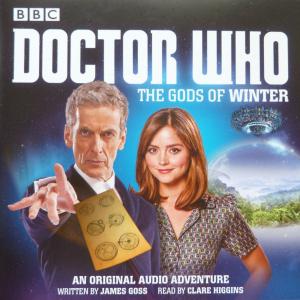
The Gods of Winter

Sunday, 16 August 2015 -  
 
The Gods of Winter (Credit: BBC Audio)
Written By: James Goss
Read By: Claire Higgins
Released by BBC Audio, 20 August 2015
Finding themselves yanked across the cosmos to a human colony world, the Doctor and his travelling companion are tasked with seemingly their most mundane mission yet: rescue an innocuous young girl’s missing cat. Suffice to say that as premises for a new yarn set in the limitless realms of Doctor Who go, this initial set-up seems neither as thrilling as that of recent TV serials like 42 nor indeed as continuity-shaking as that of The Day of the Doctor, yet it’s precisely the opening scenario which scribe James Goss lays before us with his latest contribution to the show’s mythology, The Gods of Winter.

The first instalment in a four-part series of BBC Audio releases featuring Peter Capaldi’s Twelfth Doctor as well as Jenna Coleman’s Clara Oswald – although only in name, since the studio have recruited the likes of David Schofield to narrate this interlinked quartet – Gods wastes no time in establishing the central plot arc which will bind together these otherwise standalone tales, introducing the aforementioned youth known as Diana Winter as she utilises an ominous "calling card" bestowed upon the Doctor to her ancestors for use on the worst day of each family member’s life. As was the case with Professor River Song back in 2008’s Silence in the Library / Forest of the Dead, however, the increasingly antagonistic Time Lord might well feel the desire to play Michael Buble’s "Haven’t Met You Yet" through the TARDIS’ speakers, since his initial meeting with the Winters clearly hasn’t occurred for him yet (and no doubt will be held back for the final instalment’s launch this December).

Regardless, even if answers regarding precisely why Diana’s family will have such a bearing on their newfound saviour’s life in days to come are a way off, Goss provides more than enough in the way of reasons for listeners to stick around in the meantime. Much as this reviewer jested about the subdued – to say the very least – nature of the quest placed on our time-travelling protagonists’ bigger-on-the-inside doorstep above, the situation involving the colony on which Diana resides and the apparently ruthless invaders plaguing its residents quickly escalates in unexpected ways, with the TARDIS crew forced to consider the origins of the Golhearn, a race whose motivations for serving as Gods’ supposed antagonists might not be all that they seem. Rest assured that we’ve no intent of spoiling any plot details beyond those offered in the audiobook’s précis, but we’ll at least tease that jumps in time, trips to other celestial bodies and commentaries on issues such as the dangers of blind faith and corporate legalities all factor into the piece’s overarching storyline in the seamless, inspired manner which only Goss can manage (as proven by his acclaimed past work on sub-plot laden Who romps including 2007’s The Infinite Quest).

Yet although the case of Diana’s lost feline companion does give way to a more layered, compelling adventure with political undertones aplenty, those hoping that Gods’ overall stakes would simultaneously be raised in the process might come away disappointed. Certainly, later set-pieces involving space shuttle flights across planet surfaces and seemingly abandoned religious temples up the ante in terms of action, placing both the Doctor and Clara – not to mention the first known member of the Winter dynasty – in occasionally grave danger, but if anything, this audiobook’s oft-relaxed tone at times seems far more reminiscent of that of a First Doctor serial (perhaps aptly given the representational similarities between Hartnell and Capaldi’s incarnations) than of one produced since Russell T Davies took the series’ helm just ten short years ago, a trait which could well deter any listener who approached the Twelfth Doctor’s latest audio voyage hoping for an adrenaline-fuelled experience along the lines of Into the Dalek or Death in Heaven. What Gods lacks in the way of substantial threats, however, the soon-to-be released tale compensates for with a hugely intelligent structure that initially lures the audience into wondering why Big Finish didn’t take the project on as one of their Short Trips scripts given the narrative’s supposed brevity, only for Goss to then throw a spanner in the works at the episode’s halfway point which ultimately more than justifies its (approximately) 60-minute running time.

Better yet, in the form of The Night of the Doctor star Claire Higgins (better known to series veterans as the mysterious figure who resurrected the Eighth Doctor shortly before kick-starting his successor’s plunge into the Time War), Goss has scored himself a simply ideal narrator, not least thanks to Higgins’ valiant attempts to distinguish the irritable Scottish tones of Capaldi’s Doctor, the remarkably more compassionate (if infrequently reckless) voice of Coleman’s Impossible Girl as well as the ever-maturing Diana. Whereas some of the previous contributors to BBC Audio’s various audiobook versions of the New Series Adventures novels have arguably tried and failed to capture the essence of either the programme’s current on-screen lead actors or indeed the one-off supporting players who’ve never featured on the TV show, there’s little point in denying that the first of the four thespians enlisted to bring the Winter escapades to life using their only vocal chords excels in both respects, effortlessly holding her audience’s attention as a result during both Gods’ (rare but appreciated) high-octane sequences and its calmer moments.

For a Who storyline which could quite easily have left its listeners baffled as to why BBC Audio didn’t simply transform it into a Sarah Jane Adventures novelisation, then, The Gods of Winter achieves a truly commendable number of feats, utilising its lack of action set-pieces as a means by which to tell a politically (and indeed philosophically) engaging yarn while bringing a hugely accomplished narrator into the fold so as to ensure that its audience never fails to remain captivated by proceedings. As with just about any tale intended largely to set up a broader plot arc, one could reasonably claim that the lack of genuine closure regarding the origins of Diana’s calling card robs Gods of a place amongst the higher echelons of off-screen Who, yet even if that’s indeed the case, this reviewer would gladly wager that the vast majority of those wise enough to pick Goss’ supremely accomplished latest work up will be too busy lapping up its myriad merits (not to mention attempting to predict how the story of Diana’s family tree might develop come October 1st in George Mann’s The House of Winter) to even begin to notice such incredibly minor shortcomings.


FILTER: - Audio - BBC audio - Twelfth Doctor - 1785291386